Saturday, 13 November 2010

Boat Transport Fail

A simple task. Pick up smallish boat and trailer from dinghy park, drive round to Millbrook, hand over boat, come home. Nice day out, take the dog, perhaps stop off for a pasty and a pint on the way back, lovely. Or not...


It started well enough; Ron had already checked that the boat was secure on the trailer, tyres blown up, bearings greased, trailer board tied on and working, etc. All we had to do in the morning was hitch the outfit to the back of the monster truck. A little bit more pushing and heaving than I really enjoy, but we were soon ready to go. The road that runs along the shore and up to the main road is fairly narrow, often has cars parked on either side, and is furnished with speed bumps every hundred yards or so. At the second set, Ron told me he was going to take them awkwardly as a roadworthiness test. Fail. Absolute, abject, utter fail. The offside stub axle on the trailer snapped in two, the wheel fell off and the trailer tipped over.


So there we were, monster truck with eighteen feet of trailer and a ton of boat, stuck in the middle of the road not going anywhere. Luckily, very luckily, we were still within the shadow of the two bridges, so I went walking back down the road to try and round up some strong men with toolboxes, while Ron looked for trolley jacks in the back of the truck. I found two likely looking lads in the carpark; one under a car with a spanner (he'd got a trolley jack and a toolbox!) and another 'helping' him. Off they went to the rescue while I carried on under the bridges to the pub, where I found another 'volunteer' just about to take the first sip of his first lunchtime pint. Into the fridge it went for later. Another kind person didn't just leave his coffee, he left his child on the shore (under supervision, of course). Posse rounded up.


By the time I'd walked back lots of things had happened: the police had stopped by and told him to get his triangles out (!), he'd jacked the trailer up and a couple of little green trolleys had been produced. They proved not to be quite robust enough, sadly, although they did just about serve to get the whole rig turned round and pointing back towards the river. And I had the presence of mind to start taking pictures, beginning with this one of the broken wheel and one of the broken trollies.


The next bright idea was to use a trolley jack as a roller skate under the broken axle. This looked quite good but didn't work - it just kept swinging round, even when anchored with half a mile of rope.


The final plan involved turning one of the broken trollies upside down and just skidding along on it. This worked, just about, until we had to go up the half inch kerb into the dinghy park, but generated a lot of noise, a vast cloud of smoke and an extremely unpleasant smell. It has also left a deep scratch gouged in the surface of the tarmac.


And so, finally, the trailer was backed down the slip and the boat was set free. This is the dead trailer on the slip.


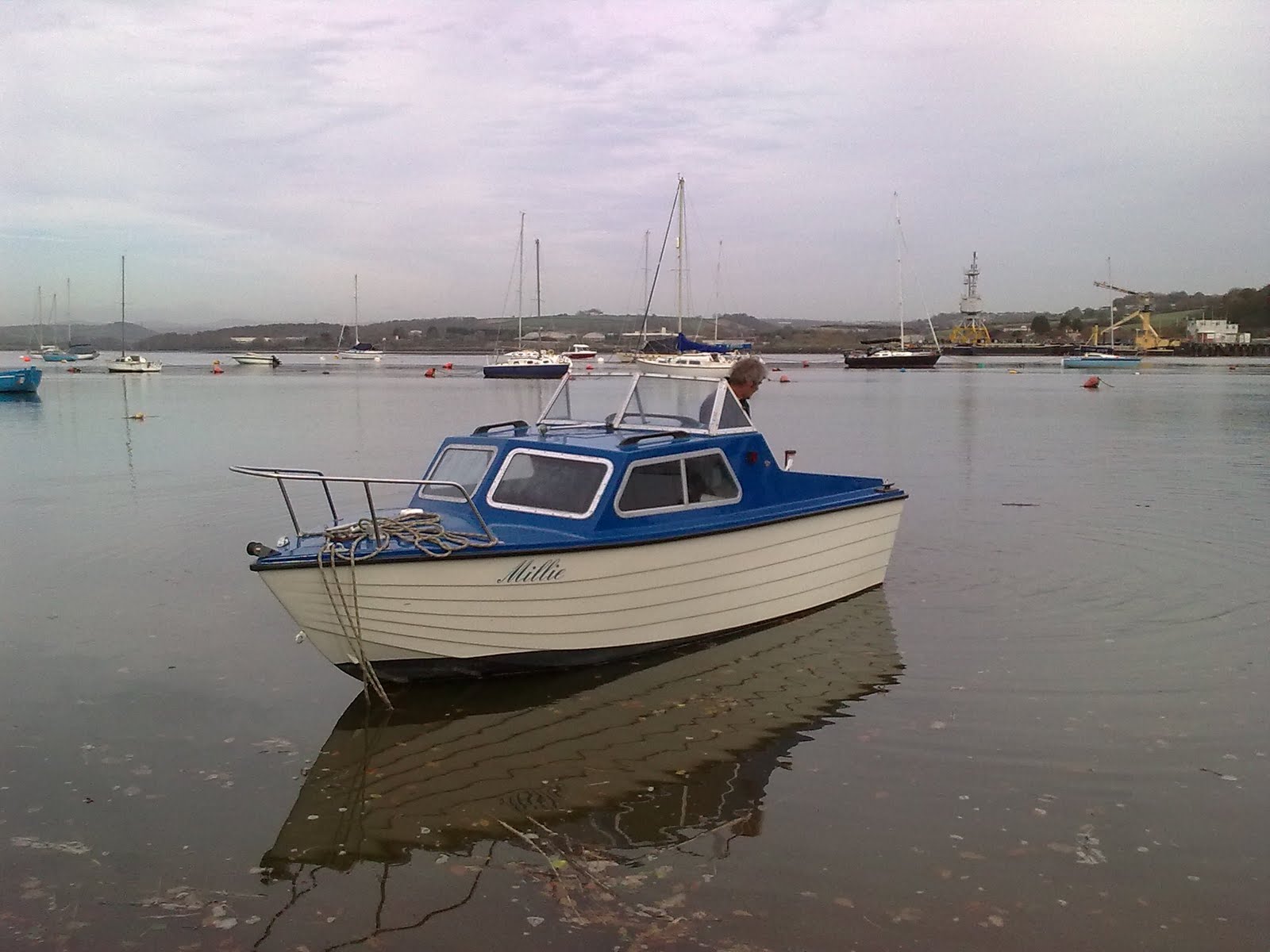
And this is the boat on the river.


That was yesterday's adventure. It had a happy ending thanks to the people who were willing to drop what they were doing to come to our rescue - we'd have been in deep trouble without them. Friends are wonderful...


I declined the opportunity to take part in today's adventure, delivering Millie by water the couple of miles down river to Millbrook - it was raining and it meant starting before dawn to catch the tide. It was, I'm told, quite unadventurous - a two boat convoy went downriver, tied Millie to a buoy (possibly the wrong one) in Millbrook lake and got home in time for brunch.


On the trailer, by road, the scenic route is almost forty miles. It would have been easier to go by water in the first place, but the new owner had bought the boat on the trailer, so that was what we tried deliver. We'll send the trailer on later, when it is rolling under its own steam again.


Sunday, 24 October 2010

Boot Test - walk from Liskeard to Looe

The German word for glove translates literally as hand-shoe. When footwear shopping, I like to look for the opposite - the foot-glove which is so comfortable that you can forget you've got feet. Not too tricky with normal shoes, perhaps, but hiking boots, which by nature have to be rather more robust than a carpet slipper, are more difficult. It's possible, though; I found some in Holland about ten years ago, long worn out, and I think I've done it again now!


The new boots arrived on the Thursday, purchased online after consultation with friends, looking at Which? reports, and trying some on in a shop. They got taken down the Coombe to the creek and back on Thursday afternoon and for a very quick walk on Friday morning, then I was away to meetings and didn't have the opportunity for a longer test until last Saturday morning. A long-planned trek down the West Looe valley from Liskeard, starting at the station there and ten or eleven miles later returning back up the East Looe Valley line by train.

This may sound like a gentle downhill stroll but it isn't! In fact, it starts by going quite a lot higher up to the start of the valley. Like most Cornish river valleys, it is steep sided and mostly wooded. The paths descend to and often cross the river, but also rise up the valley sides in places, making an interesting but fairly strenuous walk on many kinds of terrain - decidous and coniferous woodland, steeply sloping grass fields, swampy valley bottom by the river, exposed rock (mostly upended slate), some bits of tarmac lanes and wide forest tracks and finally, where the river becomes tidal at Watergate, some low-tide-only muddy shore. The heavy overnight rain ensured that conditions underfoot were as treacherous as they get, although the day itself was gloriously sunny apart from a couple of short sharp showers. The river was full and fast flowing and we came across one unfordable ford (over knee depth). Luckily the map showed an alternative path on *our* side of the river, although our first attempt at it involved climbing a steep rocky path almost to the top of the valley only to have to retrace our steps...

A good test for the boots, then. I ended the walk with warm, comfortable, dry, happy feet which didn't even feel tired. I was even just as happy to put them on again the next day for another walk.

But the day wasn't all about new boots. Much more important was the walk itself, being out in the changing seasons. The sun was still quite intense, and after the heavy rain of the night before it intensified all the autumn colours - at times it seemed that we were walking on carpets of scarlet and gold satin - and particularly the autumnal smells of pine forest, cut wood, fungi, wet grass; an olfactory feast! The dogs enjoyed the swollen river, too. We stopped for our picnic lunch on a mossy stone bridge where I suppose a road once used to be and Ty was able to indulge one of his favourite sports, swimming really hard to get upstream, barking all the while, then turning round to allow himself to be swept back down under the bridge at speed before turning to start the whole game again.

It was a glorious day - possibly the last really nice day of the season - and most enjoyable, especially with new boots and good company.

Sunday, 17 October 2010

Tamar Valley from the 'Wrong, Side - Bere Alston

I like it when a ramble in the countryside throws up questions - what's this plant? what's happening here? I like it even more when I find some answers. Last Sunday's circular walk from Bere Alston railway station, along the Tamar on the Devon side and back was one of those days.
It was a beautiful day, almost too warm in the sun but pleasant in the shade. No wind, no clouds, not at all October-like. Knowing that it was quite likely to be the last fine walking day till spring also added to that enjoyable holiday feeling. I was a bit indecisive about whether to bother with boots or just stick with the trekking sandals - there was no mud, but there turned out to be quite a lot of wet, almost frostily cold grass, so I'm glad I opted for the heavier footwear in the end. The fleece was hardly necessary, though.
From the station our party of eight humans and three dogs walked north, downhill, to the river Tamar and turned left, downstream, along it. Several of us had never seen it from that side before, pointing "Ooh, look, there's Calstock", "Look, there's Cotehele", "Doesn't the viaduct look odd from here", as we recognised landmarks from the 'wrong' direction. After travelling about three miles along and above the river we turned inland to circle round and return to our starting point.

Most of the highlights were flora, this time. Unknown flora. The first stange thing we came across were beautiful deep pink seedcases in a hedge - the seeds inside being bright orange. None of us had any idea what it was, but Google did, of course, when I got home. Common or European Spindle. An unremarkable hedgerow tree, so inconspicuous as to be invisible except for these few short autumn weeks when it is gloriously, surprisingly beautiful. One of my fellow walkers took this picture.

Another oddity we came across was almost recognisable, but not quite. Resembling a potato (which would not be in flower, indeed would have withered by now) or it's cousin the deadly nightshade (which has bright purple flowers) but covered in small white blooms, it was another one which had me reaching for the reference books on my return. Black nightshade, apparently. Why black nightshade when it has white flowers? The book didn't say...
The third vegetable mystery remains a mystery, for now. We walked round the edge of a large field planted with a root crop. The leaves of the plants appeared to have been cut (or eaten), but the roots themselves were mostly still in the ground, although quite a few were plainly visible or lying on the surface. About half of them were turnips. The other half were dark red in colour, white fleshed, with an unusual waisted, almost hourglass shape. Thus far not even Google has revealed to me their identity, nor their purpose, although I'd guess they were destined for cattle feed.
Other highlights of the walk included a heron posing in a field right next to the path, a totally unexpected "Ramblers Rest" area with tables and benches overlooking the river, a bright red microlight overhead in the brightest of blue skies, and an abandoned orchard where delicious apples fell into our hands - just one each for munching as we walked. Just enough, indeed, to keep us going till lunch, which we took in the beer garden of the Olde Plough Inn, Bere Ferrers, an excellent traditional Sunday roast.
From Bere Ferrers one can look down the river to Saltash. It's so close, so very close, less than a mile away on the wrong side of the water, but there's no way to get there so it was back in the car for a 16 mile drive home.


Sunday, 3 October 2010

Autumn comes to the Creek...

Down at the top of the creek this morning, there where the rain-swollen stream meets the rising tide, a kingfisher was fishing. It didn't see me approaching along the stream until I got within about five metres but then flew across to the far bank, calling quite loudly. As I could still hear it calling I stood quite still - even the d0g was being quiet behind me - and the bird came back to the same perch. It was a perfect photograph, silhouetted against the sun on the water. Unfortunately, by the time I had carefully eased the cameraphone out of the pocket and switched it on, the kingfisher had seen a fish, dived and was gone in a flash of blue over to the bank again.

It's not often I see kingfishers down there - they only seem to fish there just when the rising tide fills the creek and sweeps the little fishes up towards the mouth of the stream, and although it is my normal morning destination it doesn't often coincide with fishing hour. Today I also saw a sandpiper - a sign that winter is on its way - and a couple of jays, as well as the usual gang of blackheaded gulls in winter white. And having remarked to a friend a couple of weeks ago that it seemed the grey wagtails which used to nest by the little bridge seemed to have moved on this year, I've seen at least one every day for the last week!

In the garden, too, the balance of feathered visitors is changing with the season. The largest group now is the goldfinches, who often arrive ten or twelve strong and quarrel loudly and aerobatically over the niger seed feeder. The 'losers' aren't that bothered, though - they just move over to the 'normal' seed feeders and fill up from them. On the other hand, the sparrows, who keep together in a group through the whole of the spring and summer, split up and go their separate ways more at this time of the year. They still visit the garden, of course, but one or two at a time rather than in a flock. The largest number I've counted this year - about when the second brood was fledged and independent - was between thirty and forty strong. (They just won't keep still to be counted accurately!) Now, as well, the blue tits, chaffinches and great tits are reforming their loose winter flocks and including the garden on their daily patrols. In the summer they stay in the trees in the coombe, mostly.

There has been so much rain lately that all the winter springs have suddenly started flowing again in the coombe. Because the sides are so steep, it's not unusual for trees to fall occasionally, and we've lost two in the last week. A substantial young oak fell and blocked the path on the north side completely until the Council came and cleared it. They've left the fallen tree; just sawn through the trunk and branches which were blocking the path. On the other side, up at the top, a rather foolish badger had dug a new sett in the summer. At the edge of the path and under the roots of an alder, it was already beginning to undermine the path itself - my walking stick went through into a tunnel only last week - and now the tree has gone, down into the valley. I suspect it to have been a young one setting up home for the first time, and it will either start again in a better place or perhaps move in to one of the three big setts. The tree itself probably won't die, either - when they fall down the slope like that, with some roots still in the ground, they usually resurrect themselves. I hope so, anyway.

Thursday, 30 September 2010

Chester Weekend - September 2010

Chester is a lovely town which we've visited many times over the years as we have very good friends who live there. The last time I was there I broke my wrist - dancing in flipflops - but this was to be the official Annual Gathering and I wasn't going to do that this time!

We had planned a nice gentle drive up on Thursday afternoon, and all went well as far as the other side of Birmingham. There were ominous signs warning of delays due to an accident on the M6, but there wasn't much alternative choice of route, so we carried on into the inevitable traffic jam. Creeping along in first gear, in the middle lane, I began to hear a rattling noise. While I was still trying to convince Ron to stick his head out of the window and listen a car came alongside in the outside line waving and mouthing 'exhaust'! Oh dear. It's impossible to do anything when you're creeping along at five miles a fortnight, and by the time the traffic cleared we were a couple of miles short of Stafford services, so I carried on to there, very carefully, and stopped to investigate.


In the carpark it became apparent that the entire exhaust system had come unstuck and was touching the ground. Ron felt that he would have been able to improvise a replacement bracket if I'd had a metal coathanger or two concealed about my person, but I hadn't, sadly, so we had to fall back on the tender mercies of the RAC. Who came up trumps, absolutely. It took an hour and a half to reach us, mind, and by the time that welcome orange van arrived it was dark and raining, but the mechanic was marvellous. He got underneath the car, got Ron to help with pushing and pulling bits back into position and clamped and bound and glued everything back into place so we were able to carry on our journey. All with a smile on his face, too. Absolutely first class service, for which we were very grateful. There was no noticeable difference at all in the way the car was driving and we eventually arrived in Chester just in time for last orders!

We were staying with a friend but the Gathering I'd come to Chester for was based in the Queen Hotel, opposite the railway station in the centre of town. It was, I was assured, only about a ten minute walk, so early Friday afternoon I decided to check it out. Ty needed a walk, I needed to find the hotel, so off we set together. I forget, I suppose, what cities are like, as I visit them so rarely. Walking along the main road into the centre was uncomfortably busy, loud and smelly. Still, we are not such yokels that we can't operate pelican crossings or memorise a Google map, and we found our way there without incident. But not our way in. There on the steps of the Queen Hotel I had the whitegloved hand of a tophatted doorman shoved rudely in my face - dogs were not permitted through their pseudo roman door. So dog got tied to their highly polished brass railings outside while I went in to check in, briefly, and then we took ourselves home.

Perhaps it was the less than friendly welcome that started it, or perhaps it was the severe backache which started on Friday morning, but it seemed to me that the whole weekend continued in a similar vein. When I returned without the dog for the official start of proceedings I met some old friends, and was very pleased to do so, but the usual air of relaxed friendliness seemed absent, somehow and I never really got into the Gathering mood at all.

Our hostess had mentioned casually that the cycle path which runs behind her house had been extended, so on Saturday morning I took the executive decision to ignore the AGM business meeting and go for an explore. Up until now, from Lime Wood Fields one could turn right and follow a nice made cycle path along an old railway line past the centre of Chester and a little beyond it, or turn left and follow the abandoned railway line under rubbish strewn bridges and through mud or across rubble. We had been in that direction once a couple of years ago out of curiousity, but decided that it was too uncomfortable and dangerous to repeat.


Now, however, as part of what I have learnt is the Chester Millenium Greenway Project, the path has been improved and opened offically all the way to Mickle Trafford, some 2.5 miles past Lime Wood Fields. Not only is there a decent surface underfoot, but rubbish has been cleared, undergrowth cut back, new plantings made in some places, and imaginative wooden sculptures put in place. My personal favourite is this willow horse, which is just beginning to come alive. On the way we met a working party of volunteers who were continuing with the landscaping by digging a large shallow hole at the side of the track which will be allowed to fill with rainwater and become a natural pond, hopefully attracting even more wildlife to the area. The whole project is a wonderful example of what very little money but lots of enthusiasm and imagination can do to transform urban ugliness. And nice, flat, easy walking makes a pleasant change from Cornwall!

On Saturday afternoon I went back for more Gathering but just couldn't work up enough enthusiasm to stay for Sunday, so we made our way home Sunday afternoon. The journey home was comparatively uneventful, apart from the pouring rain and dreadful visibility for the first hundred miles or so - for once, the nearer we got to Cornwall the brighter the weather became. The car stayed in one piece, the roads were quiet, it was nice to be home!

Sunday, 25 July 2010

Tamar Valley Train Ride Plus

After last year's debacle struggling on and off the train to Bristol I swore I'd never take a train again, but the Tamar Valley Line is sufficiently non-mainline not to count, and I'm glad I changed my mind. Only fifteen miles long, it goes from the centre of Plymouth to Gunnislake and back through an Area of Outstanding Natural Beauty, and justifies its claim as 'one of the great scenic railways'. One second you are moving through cuttings so deep they seem like green tunnels, next you are way up in the air looking down on river valleys a long, long way below. If you can look out of both windows at once it's possible to catch glimpses of both rivers - the Tamar and the Tavy - at the same time.

But ours was primarily a walking day, with the train just a different way of getting there, so we didn't go to the end of the line or take a break at the Tamar Belle railway visitor centre at Bere Ferrers (it was noted down as a place to take nieces and nephews, though) but got off at Calstock, just on the Cornish side of the Great Viaduct over the Tamar.

Plan A was probably (I think) to walk along the river to Cotehele Quay, perhaps up through the grounds and look at the house (from outside only because of the dogs) and wander back, perhaps even taking a ferry ride. But we got a bit carried away with 'I wonder where that path goes?' and took a long loop up and behind the Cotehele estate, finding some fascinating bits of 'industrial heritage' on the way, then had a panic because some paths were closed and set out cross country for the folly/viewing tower which marks the edge of the estate. This strategy resulted in some rather muddy feet (that special mud that young cattle churn a perfectly respectable field into), a difficult gate or two and a scramble over the wall behind the tower in a place which had obviously been used for the same purpose many times in the past but was still protected on both sides by barbed wire and on the top by brambles. Between the six of us we own (I checked) three copies of the relevant Ordnance Survey map, but none of us had brought it because we all thought we were familiar enough with the area not to get lost. Another lesson learned! When we got back to the Quay and looked at a map it was obvious that the official public footpath doesn't go anywhere near the estate at that point.

Having broken in to the estate, so to speak, behind the folly we then took a leisurely stroll round the edge, looking at the newly planted Mother Orchard with its 270 tiny trees of old apple varieties (and a splendidly organic sculpture of a hand holding an apple), past the picnic area and the car park, down through the woods to the Mill and along the river to the Quay, where we thought we'd get a spot of lunch. No such luck; after queueing for some time at the place of refreshments, which promised pasties in several flavours and other delights, we discovered that he had nothing left but icecream. One of our party had gone home for lunch by then, but we rustled up two apples and two muesli bars between three, and the other two had icecream. The daft thing was that having realised en route that nobody had thought to bring dog treats, an emergency diversion had been organised to get some in Plymouth while waiting for the connecting train; shows where our priorities lie! Yet another lesson learned - always take emergency food, just in case...

We then headed back to Calstock along the river. Or rather up a very long hill and down the other side while the river meandered flatly through reed beds below us. We got to Calstock after the pub had stopped serving lunches (it was that sort of day), but luckily the local shop had a few cold pasties still in stock. Pasties were always intended to be eaten cold, of course, and these were actually very good ones, eaten on a riverside bench before we climbed wearily back up the hill to the station for the return journey.

Wildlife highlights of the day were mostly butterflies: not all that many, but a good variety including peacocks, red admirals, fritillaries, various whites, gatekeepers and a few more. There was some seriously competitive photography going on, too, with elbows and worse being used by two of our party to be the first to get to the perfect openwinged shot. I, too, took a photograph - there was a Jersey Tiger moth clinging quietly to the noticeboard on Saltash station, and I captured it with my phone camera. It was obliging enough to stay still while I worked out how to use the zoom, even...

After catching the train from Saltash to Plymouth in the morning without incident, and the lovely trip on the Tamar Valley Line, it was a pity that Great Western rather blotted their copybook right at the end, by putting on a wholly inadequate two coach diesel for the main Sunday evening train from Plymouth to Penzance. To say it was packed would be an understatement; and the vast majority of the passengers seemed to be either returning students or holidaymakers, with vast quantities of baggage. Dogs don't like people walking on them from three directions at once, and nor do I. At least I had a seat - a pull down one in the space between the coaches - the rest of our group were even more uncomfortable. And I was only on the train for fifteen minutes. Still, even that unpleasantness didn't really spoil the day...

Wednesday, 30 June 2010

Across the seas to Lundy

Lundy Island sits in the middle of the Bristol Channel. It's had a chequered history, having been owned by, among others, in the thirteenth century a gentleman who plotted against his king, lived by piracy and was eventually hanged, drawn and quartered, in the eighteenth century by a corrupt MP who got a contract to transport criminals to America but took them to Lundy and used them as personal slaves, and in the nineteenth by a gentleman whose life's ambition was to build a church. Long (3.5 miles) and thin (half a mile) it also presents a hazard to shipping and boasts three lighthouses, one at each end (working) and one right on the top (abandoned because it was too often above cloud level).

Before yesterday all I could have told you about Lundy would have been where it is and that is has puffins. That's what we went for, basically, looking for puffins, but what we got was much, much more. It's a long way, too, from here to Bideford - a two hour drive - for the 7.30am boat ride, so the adventure got extended to an overnight in Barnstaple beforehand. Four of us set out from Plymouth on Monday evening, arriving in Barnstaple in time to have a very pleasant and reasonably priced meal in a lovely old place called The Cedars, which sadly was closing for refurbishment almost immediately afterward. And an early night for a 6.00am start for Lundy!

The weather's been settled, hot and sunny, for weeks now - it has become my habit to cover my face with factor 50 sunblock straight after my morning shower - but the forecast for Tuesday was a little uncertain. There was nothing uncertain, however, about the downpour which woke me just after 3.00am. And it was certainly still raining when we got up at 6. Still, we'd come all this way to visit Lundy, so I turned my sunhat inside out, put on all the layers of clothes I'd brought and off we went.

The Oldenburg makes regular trips from Bideford to Lundy. It takes supplies, passengers, post, everything. Assembled on the quay yesterday morning in the pouring rain were 262 souls, all a little dejected. Most, like us, were taking a day trip, a few would be staying in the holiday accommodation on the island. The other members of our group consisted of two from Exeter who had driven down in the morning and a family of five from Salisbury who had only arrived back in England from Sri Lanka the day before and were a little jetlagged, to put it mildly. We all filed on to the boat. Due to the inclemency of the weather, the interior accommodation was very quickly bagged by the people at the front of the queue and four of us found ourselves squashed on a bench for three outside by the aft gangway, sitting on a wet wooden bench in the wet air.

And we were off. The captain announced the sea state was 'slight' by which it quickly transpired he meant slightly choppy. A young crew member spent the whole two hour journey walking round solicitously dispensing sick bags. Our small corner of the deck quickly became even more crowded with unhappy clingers to the rails. On the plus side, it stopped raining, and there were bacon sandwiches to be had. A bacon sandwich, I always find, helps in a choppy sea. We reached our destination just after ten. As we arrived the captain announced that a (voluntary) round-the-island trip would be available in the afternoon before the scheduled departure back to Bideford - I didn't see much enthusiasm for the idea.

Our whole trip had been organised around the availability of our own personal guide to the island, and he was waiting for us on the quay. He was brilliant as a guide, was Simon, both knowledgeable and enthusiastic about all aspects of the island, its past, present and future prospects, the wildlife (puffins and other birds) and the introduced life (sika deer, soay sheep). After some brief introductions and a quick check on preferences as to what we'd like to see, off we set.

It's in the nature of islands, particularly small ones, that one arrives at the bottom and all the interesting bits are at the top. Four hundred feet up, to be precise, which was a bit of a challenge, but I got there. It helped that it was in short stages with stops for explanations. At the first stop, only fifty feet up or so (Trinity House landing stage) I was happy to get rid of the waterproof and fleece I'd started the day in, by the time we got to the Village (about two thirds of the way up) my sunhat was back the right way out, but I waited rather too long to get the anti-sun applied and went a bit pink in places by the end of the day - so did almost everybody else!

In the village there's a pub/tea room and a shop, and a mini museum which consists of wallboards with highlights of the island's history and a small display case in the middle. On top of the display case is a stuffed gannet in a glass case. I like gannets, but when I later enquired whether we would see any I was told that they don't nest on the island any more. I wonder whether this is in solidarity with their poor motheaten brother in the glass cage.

Upward and onward from the village to the central plateau of cultivated fields. As we passed through a gate there were a small herd of sika deer (a stag and a dozen or so hinds and young ones) posing beautifully on the skyline. They were far enough away to be unworried by us, but close enough for inspection through binoculars and photographs. Eventually they wandered off, down to a fence which they leapt in turn into an area of bracken and bushes. We went on through fields of sheep to a more open moorland area where there were Lundy ponies. These were originally a cross between New Forest ponies and a Welsh Mountain stallion but are now classed as a breed on their own. Tall for ponies, quite elegant, with beautiful gold or copper coloured coats.

By now we had crossed to the cliffs on the west side of the island and our guide took us to a clifftop where we had our picnic lunch and puffin watch. I must admit that given the amount of fuss they make about the puffins - almost every item in the shop was puffin branded, for example - I was expecting a large colony. Our guide explained that the colony had almost been wiped out by black rats, and was only just now recovering after the eradication of the rats. There are appoximately fifty birds, with about ten active nests, that's all. But they posed for us nicely on the other side of a little cove, halfway up a cliff. There were other birds on the cliff as well, guillemots and razorbills and a few gulls, but the puffins were the prize.

It's interesting that everybody present accepted the need to get rid of the rats to preserve the puffins without demur. When I mention to people that my nephew in New Zealand is working on the eradication of hedgehogs from his islands they are usually horrified. But the hedgehog in New Zealand is just as much of an introduced pest destroying the native wildlife as the black rat was on Lundy, surely?

After lunch we walked back inland, across moorland full of wheatears, skylarks and chocolate brown soay sheep, up to the original lighthouse on the very highest point. Built in 1819, designed by the same man who created Dartmoor prison, it wasn't a great success because it was too often invisible due to fog or low cloud. It makes a great vantage point, though; the one member of our party who made it to the top claimed he could see America! From there it was time to descend a little way back to the village for a most welcome tea break in the welcoming Marisco Tavern, which had a generous library of reference works, bird and wild flower field guides, and I amused myself by identifying an unknown pink flower we had come across as Centuary, one I'd not met before. One or two of our party opted for the trip round the island (they saw seals!) but most of us stayed on land, checking out the church and the castle, looking down on the South Lighthouse (unreachable from where we were) and generally wandering about until it was time to go home.

There was no sign of the sick bag dispenser on the way home; an altogether much more peaceful crossing. I did see one gannet and a few cormorants but, alas, no exotic marine creatures at all - I'd hoped for a basking shark or two. Altogether it was a memorable and thoroughly enjoyable day. The weather was kinder to us than we had anticipated, the deer and the puffins posed nicely, the island lived up to expectations. But it would not have been anywhere near as good a day without our guide. On the cliffs we met quite a few disappointed walkers who hadn't seen a single puffin, mostly because they didn't know where to look. Simon took the time to steer all of them in the right direction, as well as treating us to a proper display. But there was a lot more to the trip and the island than just bird watching, and it was thanks to him that we were able to get so much out of it.

I'd love to go again, I'd love to stay and explore Lundy properly. Unfortunately, however, the one strict rule they have there is that dogs are forbidden. And a day trip is about as much as I can manage without my dog. Or my man, come to think of it...